In July 2025, a field demonstration event focusing on the integrated development of smart agriculture and mechanized plant protection was successfully held at the core experimental and demonstration base for soybean-maize intercropping in Tongshan District, Xuzhou City. The Smart Plant Protection Application Technology and Equipment Team from the College of Agricultural Engineering, Jiangsu University, conducted on-site demonstrations of pesticide application machinery under the soybean-maize intercropping pattern, attracting widespread attention from local agricultural departments, cooperatives, large-scale growers, and multiple agricultural machinery enterprises.
The pesticide application machinery showcased in this demonstration was independently designed and developed by Jiangsu University under the National Key Research and Development Program. Addressing challenges such as narrow row spacing, intertwined plants, and varying growth layers in intercropping systems, the team created a specialized pesticide applicator for soybean-maize intercropping. This machinery incorporates an intelligent sensing and path control system, is equipped with an efficient boom structure and an autonomous shock absorption control device, and features functions such as precise obstacle avoidance, terrain-following, and quantitative spraying. It effectively resolves issues prevalent with traditional sprayers in intercropping patterns, including low operational precision, poor pesticide utilization rates, and severe drift pollution.
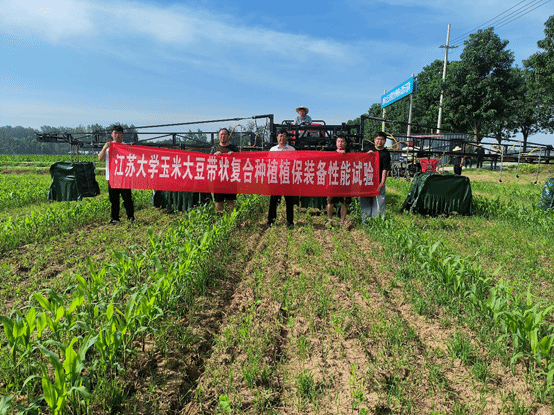
During the on-site demonstration, the equipment operated stably in the strip-planted fields, with uniform pesticide spraying and precise operational trajectories, earning unanimous praise from all attendees. Professor Jia Weidong, the leader of the Smart Plant Protection Application Technology and Equipment Team from the College of Agricultural Engineering at Jiangsu University, also provided a detailed explanation to the on-site personnel regarding the equipment's working principles, operational procedures, and adaptability analysis. He engaged in interactive exchanges with the growers as well.
Professor Jia Weidong stated that in the next step, the team will continue to focus on the technical bottlenecks in crop intercropping systems, deepen integrated "industry-university-research-promotion" cooperation, and promote the practical application of more intelligent agricultural machinery and equipment in the fields. This effort aims to inject technological momentum into safeguarding national food security and promoting green agricultural development.